

Recognising a product gap in the market can give birth to tools that can revolutionise an entire industry, all while challenging industry titans like Adobe.
Melanie Perkins (CEO & co-founder of Canva) pinpointed the complicated learning curve of designing programs, which required months of understanding to use, while teaching design programs at the university.
“We didn’t really worry about competitors at all,” she said in an interview. “We actually just saw a gap in the market that we can uniquely fill.“
If you lack Photoshop skills, use Canva: That is how most are introduced to the product. But this unmistakable “ease of use/drag & drop” interface is precisely what put Canva where it is right now,
A staggering $42 billion valuation, rightfully so.
Canva has filled a massive gap between customers (people who need creative designs) & the steep learning curve that usually comes with high-end design software like Photoshop.
As a user, I value an intuitive user experience that prioritizes ease of use without compromising its intended utility. Canva, from the very beginning, focused more on ease of use and great aesthetics; it is a design tool, after all.
Canva was the first service I used for this blog (still use to this day) for social media promotion and other key design aspects.
The selling point? Freemium membership!
While I was still pursuing my engineering degree and building this website, I needed high-quality designs & graphics to add to it and promote it on social media. No way I could hire designers at that point (a broke college kid with no money).
Canva does have a paid membership, but its basic design features aren’t reserved for premium members only; this alone builds loyalty from day one.
I did switch to the paid program a few years ago, not because of the previous paywalled features, but because Canva has a plethora of elements whose benefits I wanted to utilize fully.
Despite all the glory it has today, this Australia-based juggernaut was rejected over 100 times before securing any funding, yet it delivered something no other design software offered at the time.
Let me walk you through the journey Melanie Perkins, Cliff Obrecht (husband & co-founder), & Cameron Adams (co-founder) had to take in order to make Canva the success it is today.
Table of Contents
Notable key stats of Canva:
- Monthly Active Users (MAU): As of their 2025 review, over 260 million monthly users in over 190 countries.
- Annual revenue: surpassed $3 billion in ARR mid-2024 to early 2025, projected to cross $3.5 billion annually before 2026.
- Reportedly, more than 95% of Fortune 500 companies utilize Canva’s services.
- In 2024, Canva expanded its team by 1,000 employees and, in March, acquired the UK-based design software company Affinity. Additionally, it launched Dream Lab, a generative AI tool powered by Leonardo.
- Despite its substantial growth, Canva remains privately held for now, with a public listing on the US Nasdaq anticipated in 2026 or maybe later. Post IPO valuation may boom multi-fold.
Source: https://www.canva.com/newsroom/news/canva-2025-wrap/
1. The Story of Canva: How it actually came to existence?
Melanie, while studying communications & commerce at the University of Western Australia, came across a recurring problem of designing yearbooks with limited resources that lacked
“Students weren’t learning design, but rather were battling complicated software.”
The constant friction in learning was well established, and that needed major changes.
The realisation of a simpler interface was very apparent when she, as a design teacher herself, claimed that the kids don’t actually need to understand the software’s full complexity for even the simplest design needs.
There’s a saying, if you need something that doesn’t exist just yet, build it yourself.
In the fall of 2013, Canva was partially launched via a waitlist-to-join option and username reservation, and it finally launched to the general public in 2014 after major hype around the product, with around 50,000 waitlist signups.
And even to reach this level, the team had to run through multiple rounds of trial and error to validate the idea’s viability.
To do so, Melanie and her co-founder, Cliff Obrecht, launched Fusion Books, an online design platform for students to create their school yearbooks, which grew very popular throughout Australia, New Zealand, and France.
In 2013, Canva secured seed funding of around $3 million and $6 million in early VC funding. Soon enough, in Oct 2015, they raised a Series A round of around $15 million, bringing their valuation to $156 million.
By 2025, Canva had raised over $572 million in total funding, making it one of the very few companies to do so, and currently has a valuation of around $37 to $42 billion.
2. Became too big to ignore
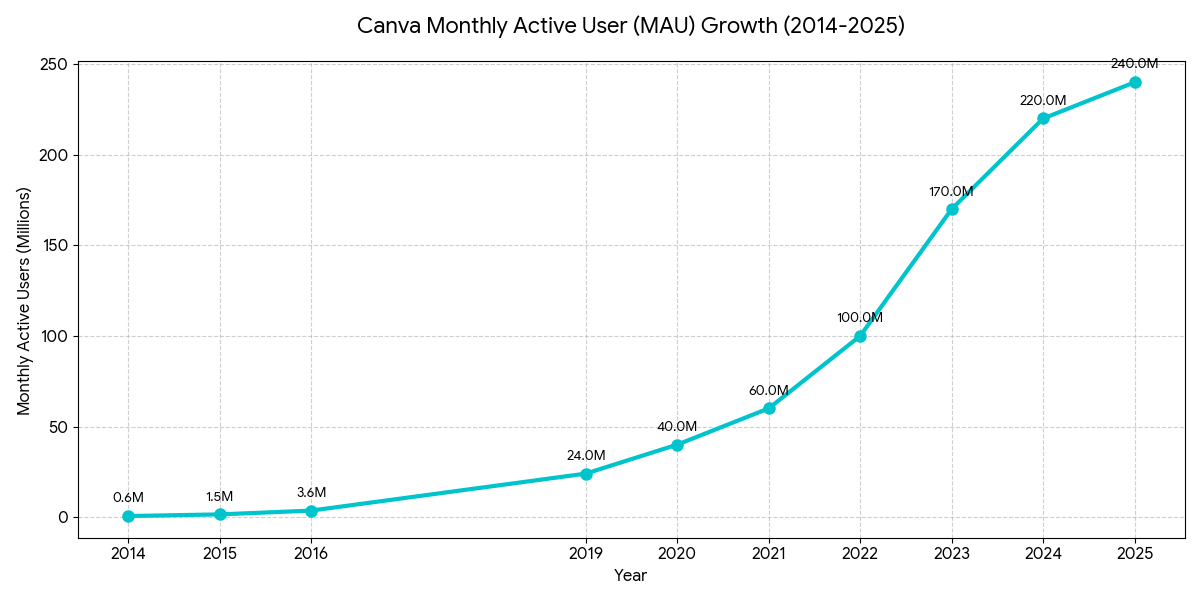
As stated before, even after the initial waitlist of over 50,000 registrations, by the time Canva finally launched, it had grown to over 100,000 users. And then 0.6 million in 2014 to over 240 million in 2025.
Canva unknowingly fueled much of the social media marketing that boomed after 2015-16, as most businesses and individual creators turned to Canva to design social media posts.
Safe to say, it rode the creator/social media wave perfectly.
The image above gives you a clear idea of how quickly Canva rose to become the popular kid in school.
One of the contributing factors for this growth lies in how Canva effortlessly democratised design.
Before Canva:
- Design only meant: Photoshop, Illustrator, agencies, or skilled freelancers
- High learning curve + high cost
- Non-designers avoided visuals or did them badly
What Canva solved:
- Easy drag and drop predesigned elements
- Hundreds of templates to choose from instead of blank canvases staring at you
- Giving it a very fresh, professional look
- Easy collaborative tools among teams
What was once tossed around and rejected pre-seed is now being gobbled up in Silicon Valley.
3. Turning its customers into organic promoters
Right on top of my head, I can recall at least 4-5 people I’ve talked into using Canva since I started. Steller products market themselves.
I’m sure it was the same for most of the people who came across the platform and have been a rather loud promoter of the product.
Every time someone would ask, “Where did you make that?”
Canva!
With the further introduction of collaborative tools such as Canva Teams, link sharing, client handoffs, and “view only” links, the sharability aspect was ingrained throughout the product’s workflow and worked as a silent marketer.
During the early days, Canva aggressively entered educational institutions, making educators its unpaid distribution partners.
And after graduating, the students continued using Canva as their primary design tool, for its obvious reasons
4. Integrating AI to further solidify an edge in the market
Post the AI boom, since the launch of LLM (large language models) such as OpenAI’s ChatGPT and Google’s Gemini, most tech startups and businesses have integrated (or have at least tried to) these AI models to automate or enhance certain aspects of their existing operations.
In October 2023, Canva launched its AI Magic studio in collaboration with OpenAI, enabling users to issue natural-language-like commands to accomplish tasks and generate AI content.
This update opened the floodgates of creative possibilities among the user which included features like:
- Magic Write – AI writing tool powered by OpenAI’s API
- Magic Design- Canva’s design generation tool, paired withOpenAI’s API to generate presentations, social media posts, images, videos, and graphics.
- Magic Switch: This tool instantly converts existing design formats to other formats. Can auto translate into other languages, shift orientation, and can even change a single poster into a full-fledged presentation.
So Canva managed to pivot the AI ripple to build a comprehensive design platform, a one-stop shop for creative work.
5. Future IPO plans
Despite all the major wins, Canva remains privately owned (for now) and might already be preparing for a public debut behind the scenes.
In an interview, Melanie mentioned she has a big wall in the office that captures the company’s big vision (kinda like a vision board) and how Canva can be developed into a means to improve the upcoming years (as if it isn’t already haha).
Whatever the IPO plans Melanie & her team have for Canva, will be announced in their due time.
Regardless, Canva is & will be a star product in every household that continues to empower creative minds.