


Data entry is one of those online job categories that almost everyone thinks they understand (due to its simplicity, as the job entails), until they start looking for real listings.
I may or may not have looked for such jobs while I was pursuing engineering in college for some extra cash, but I didn’t end up pursuing them because I’m prone to making silly mistakes (I use Grammarly for a reason)
But if you’re good with crunching numbers or following instructions and doing exactly as the job demands, you might just be the right fit.
It can be a great, beginner-friendly way to earn from home, especially if you’re reliable and fast, but it’s also a category that attracts more scams than most.
And because it’s “easy to start,” competition can be intense on the big platforms.
So if you want a real shot at landing data entry work, you need two things:
- a clean, repeatable setup (skills + tools + proof), and
- a smart job-hunting system that avoids the traps.
According to Payscale.com, Data entry jobs pay an average of $41,156 a year, with salaries ranging up to $61,000.
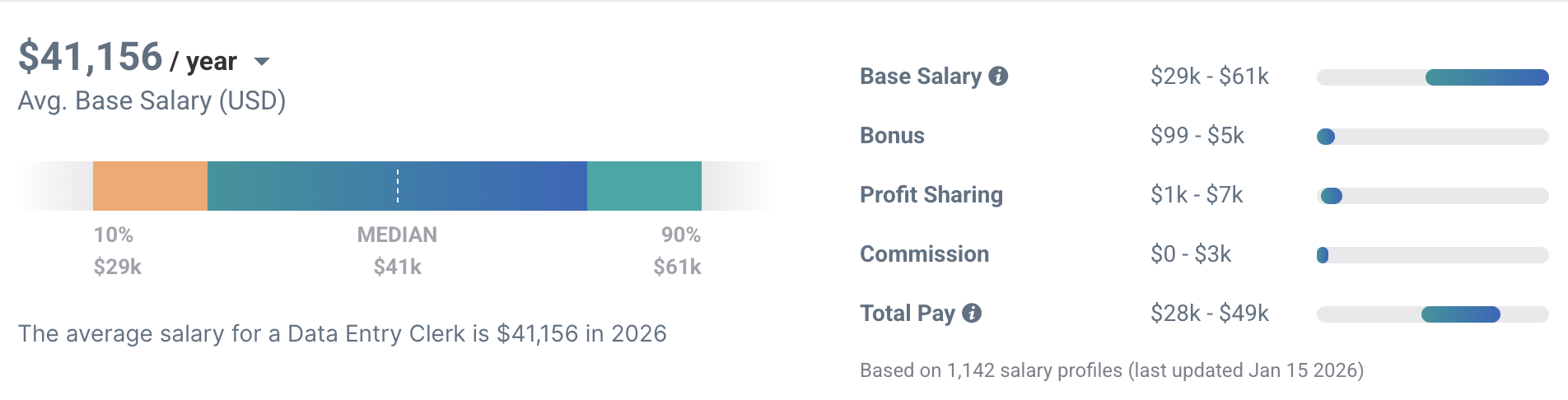
Table of Contents
What is actually required of you?
Clients hiring for data entry want trust, speed, and consistency.
1) Typing speed (but accuracy wins)
You don’t need to be a typing champion. But you do need to be accurate, not my strongest suit; that’s why people who excel in accuracy are in this business.
Many companies and platforms mention minimum typing speed expectations. For example, some listings and companies commonly look for 50–60 WPM with accuracy standards.
2) Spreadsheet comfort
If you can confidently use Google Sheets or Excel—basic formulas, filters, sorting, duplicates removal—you become far more employable. You’ll see these requirements come up repeatedly in listings.
3) Follow instructions as if your paycheck depends on it
Because it kinda does. They don’t want a specific task done how you like it; they want it exactly as they want it, nothing more, nothing less.
Data entry is full of tiny rules. The client may want:
- Dates in a specific format
- All caps for certain fields
- No abbreviations
- Strict naming conventions
4) Research + common sense
A lot of “data entry” is actually figuring out what the correct data should be, not just typing. That’s why web research skills (and being careful about sources) matter.
Your Starter Setup (The Art of Looking Like a Pro From Day 1)
You don’t need fancy tools, but you do need a clean setup:
- A laptop/desktop (data entry is painful on mobile, trust me, I tried)
- Reliable internet
- Google Workspace or Microsoft Office access
- A simple portfolio (yes, even for data entry, proof of previous work )
A Roadmap to Land Your First Data Entry Job
Step 1: Pick your lane (for the next 30 days)
Choose one primary lane:
- Freelance data entry (clients + projects)
- Remote employment-style data entry (companies hiring contractors/employees)
- Microtasks/AI data work (small tasks, flexible)
Trying everything at once makes most people quit.
Step 2: Create a focused “service headline”
Instead of “I do data entry,” say something like:
- “Accurate spreadsheet data entry + cleanup (Google Sheets/Excel)”
- “Lead generation + contact list building (LinkedIn + websites)”
- “Product catalog entry + formatting for e-commerce stores”
Step 3: Apply daily, but smarter
Aim for 5–10 quality applications per day for 2 weeks. Most people apply twice, get ignored, then assume “it doesn’t work.” But keep at it, all you need is one “yes” to start.
15+ Legit Resources to Find Data Entry Jobs
Some are freelancing marketplaces, some are job boards, and some are companies/platforms that regularly offer data-style tasks.
1) Upwork
If you want freelance-style data entry (clients posting projects), Upwork is one of the biggest marketplaces. It has a dedicated data entry category where you can see active listings, client history, budgets, and required skills.
The key to winning here is not sending generic proposals.
Attach a sample spreadsheet, specify your accuracy standards, and pitch a narrow service (such as lead list building, CRM cleanup, or PDF-to-Excel formatting).
Start with smaller fixed-price projects to build reviews. (Upwork)
2) Fiverr
Fiverr works differently: instead of applying to jobs, you list “gigs” that people buy. Data entry is a major category on Fiverr, including sub-services like data typing, formatting, and cleanup.
The way to stand out is by creating 2–3 sharply defined gigs (for example, “clean and format your Excel sheet in 24 hours” or “build a verified lead list of 200 contacts”).
Fiverr is great for beginners who can package simple deliverables clearly. (Fiverr.com)
3) FlexJobs
FlexJobs is known for screening listings and focusing on legitimate remote/hybrid opportunities.
Their remote data entry section is useful if you want more “job-like” roles (part-time, full-time, contract) rather than random gigs. It’s especially good if you’re tired of scammy job boards.
Use filters aggressively: entry-level, remote, flexible, and part-time options are common starting points. (FlexJobs)
4) Indeed
Indeed is a volume game—tons of listings, and you’ll need to filter carefully.
The upside is that you can find local, remote, and hybrid data entry roles, and listings often include skill expectations (such as spreadsheet knowledge and typing accuracy).
The downside is that you must vet employers. Use Indeed to build a habit: search daily, filter for remote/work-from-home, and apply quickly to fresh postings. (Indeed)
5) Remote.co
Remote.co is helpful because it’s built around remote-first jobs and includes a category specifically for online data entry roles.
It also has general guidance on what data entry is and what skills employers expect, which is useful when you’re brand new and don’t want to feel lost reading job descriptions. (Remote.co)
6) LinkedIn
LinkedIn is often overlooked for data entry because many companies post contract admin roles there that involve heavy data work.
The trick is to look beyond “data entry” and include terms such as “data specialist,” “operations assistant,” “catalog coordinator,” or “CRM administrator.”
Also, your profile matters: add a line like “Google Sheets + Excel | data cleanup | lead list building” and you’ll appear in more searches. (LinkedIn)
7) Freelancer.com
Freelancer is another marketplace where data entry projects are posted constantly.
Like Upwork, bidding is competitive, so you need a simple strategy: pick a niche (Excel cleanup, PDF conversion, web research), keep your proposals short, and attach proof.
Freelancing is good for building early momentum if you treat it like daily prospecting. (Freelancer)
8) PeoplePerHour
PeoplePerHour has a steady stream of admin and data-entry-style jobs, especially for clients in the UK and Europe.
They also emphasize vetted talent, which can improve client quality once you’re approved. It’s a good place if you want project-based work but prefer a slightly more curated environment than the biggest gig platforms. (PeoplePerHour.com)
9) Axion Data Services
Axion is a well-known company that offers data entry and online research contractor opportunities when openings arise.
Their employment page is the correct place to check (and they mention registering/keeping an eye on openings).
The important thing with companies like this is patience: openings can be periodic, and competition is high. (Axion Data)
10) DionData Solutions
DionData is often mentioned as a company associated with data entry, and there are discussions about their typing requirements and expectations for computer knowledge.
If you’re applying to companies like this, make sure you have a clean resume that highlights typing speed, accuracy, and spreadsheet familiarity, because they tend to be pickier than “open marketplace” gigs. (Indeed)
11) SigTrack
SigTrack is known for petition/voter-registration style processing workflows where contractors work through a system with specific “specs” and pay rates per job.
One critical note: availability and hiring status can change, and their own “Getting Hired” page should be treated as the source of truth for whether they’re currently onboarding.
Always check that directly before spending time preparing. (sigtrack.net)
12) Clickworker
Clickworker is a microtask platform where workers can complete tasks such as data processing, research, and categorization. It’s not the same as a traditional “data entry job,” but it’s a realistic starting point if you want flexible tasks and you’re okay with building income gradually.
Treat it like practice: you’re training your accuracy and speed while earning. (clickworker.com)
13) Amazon Mechanical Turk
Amazon Mechanical Turk (MTurk) is another microtask marketplace. Tasks can include data de-duplication, transcription, research, and validation.
It’s flexible and can help you get started fast, but pay varies widely, and you need to learn which task types are worth your time.
If you approach it systematically (tracking earnings per hour and focusing on better requesters), it can be a workable entry point. (mturk.com)
14) Remotasks
Remotasks offers paid online tasks, such as transcription and labeling. They also emphasize training to unlock more projects, which matters because better task types often come after you complete courses.
If you’re open to “data work adjacent” tasks, this can be an option—just treat it like skill-building at the beginning rather than expecting perfect income immediately. (Remotasks)
15) Appen (including CrowdGen)
Appen is widely known in the AI data space—projects can involve data annotation, evaluation tasks, and other guideline-based work.
Their CrowdGen platform positions this as paid remote task work that supports AI improvement.
This is a good fit for people who are comfortable following detailed instructions and working on quality-controlled tasks. (Appen)
Stay Away From Scams
If you search “data entry work from home,” you’ll see ridiculous offers like:
“$40/hour typing job, no experience, immediate hire” or ” pay this much amount to get started”.
More often than not, it’s bait.
A good rule: legit jobs don’t ask you to pay to start.
If anyone asks for “registration fees,” “training fees,” or “equipment purchase” before hiring, better to leave it at that.
Bonus stuff: If writing and expressing yourself are something you’re keen on or would like to explore through writing blogs, head over to my “How to start your own blog” guide that’ll help you launch your blog by today.
Ending Notes
Data entry isn’t glamorous. But I personally know some people who love this kind of work, where you just shut your brain off and don’t have to do deep research, and that’s exactly why it works.
- Build a small portfolio
- Pick 2–3 platforms
- Apply consistently
- Protect yourself from scams, and you’re good to go.
All the best, and do let me know if you need any specific help in this whole process.
Get data entry-ing, that’s a word, right?
Yes I’m interested